
LEND A HAND, NOT A HANDICAP: ACCESSIBILITY IN FINTECH 

What if I told you that the future of lending could hinge on something as simple as a button? Sounds absurd, right?

Microfinance Institutions & Small Finance Banks primarily serve underserved communities. Yet every day, potential borrowers—small business owners, farmers, or sometimes even tech-savvy millennials—slip through the cracks either due to physical/cognitive disabilities or maybe just by being out of touch with technology.

Accessibility in Fintech

Misinterpreting an unlabelled alert/warning indication in red due to colour blindness, or lack of alternatives for documentation could mean the difference between growth and stagnation or worse, result in approaching unsavoury means of availing loans which at the time may seem more convenient, like borrowing from loan sharks without legal involvement or security.

While the RBI has made significant strides in ensuring physical accessibility for individuals with disabilities in the banking sector, such as mandating ramps and braille keypads for ATMs, wheelchair-accessible bank branches, there is still room for improvement, particularly in the realm of digital products. How can we ensure accessibility in our apps and softwares? Here are a few tips:

1. Leverage assistive technology
For users with disabilities, assistive technologies like screen readers, voice-to-text, or even gesture-based navigation are essential. By incorporating assistive tech, you’re ensuring that everyone, regardless of their abilities, can confidently access loans through your app.
2. Avoid relying on fine motor skills
For some users, interacting with small buttons or precise swipe gestures can be difficult, particularly if they have motor impairments or are using basic smartphones. Ensure that all interactive elements are large enough to be tapped easily and consider adding alternative input methods like voice commands or gesture navigation. This makes the app more inclusive for a wider range of users.
3. Optimize for low bandwidth and offline access
In many parts of India, especially rural areas where MFIs play a big role, internet connectivity can be unreliable. Your app should be optimized for low bandwidth, ensuring it works smoothly on slow or unstable networks. Additionally, consider incorporating offline functionalities, allowing users to fill out forms or save their progress regardless of network conditions without disrupting the application process.

4. Don’t forget about colour blind users

Here’s an interesting stat—according to research conducted by IJCMR in 2020, about 3.89% of men and 0.18% of women in India are colour blind. however, most cases go undiagnosed and according to Economic Times as of 2023, roughly 70million people in India are experiencing it. That’s a lot of potential borrowers!

So, when using colour to convey meaning (like warning users about missing documents), always make sure there’s a backup, like an icon or text label. Accessibility isn’t just a compliance checkbox—it’s a commitment to removing barriers, enhancing usability, and making your platform intuitive for everyone. By designing inclusively, you not only serve a broader audience but also demonstrate a thoughtful, user-centered approach that builds trust and loyalty among all users.

It’s all about removing guesswork!


5. Provide multiple authentication options
For many, especially first-time users or those unfamiliar with tech, authentication methods like OTPs, passwords, or CAPTCHAs can be a hurdle. Offer simpler, more accessible alternatives like biometric authentication (fingerprint or face recognition) to streamline the login process.
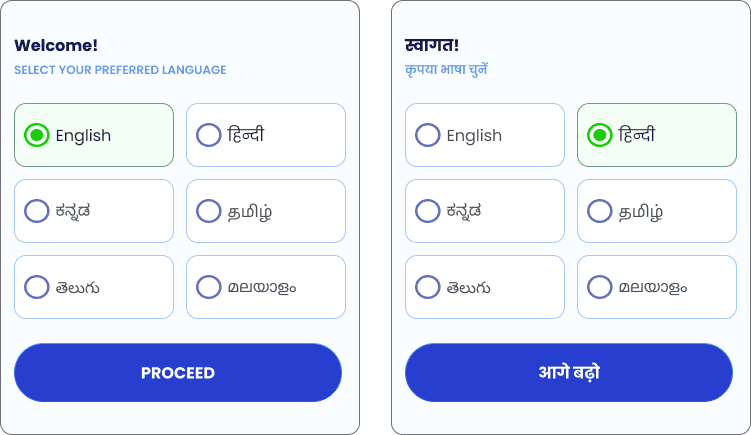
6. Speak their language
India is a vibrant mosaic of languages, with each region reflecting its own unique linguistic and cultural identity. So why not tap into that diversity? Offering an app in multiple local languages not only broadens reach but also creates a deeper connection with users by showing that you respect their culture and are committed to serving them. Additionally, pay attention to design details, such as ensuring compatibility with scripts written from right to left, to provide a seamless user experience for all. This thoughtful approach not only enhances accessibility but also strengthens trust among diverse user bases.7. Build community support
While AI chatbots might be all the rage, consider integrating easy-to-access customer service options within the app, such as FAQ or a click-to-call button. Some users, particularly older or less tech-savvy ones, may prefer speaking to a human representative over a frustrating loop of inputs with a bot while dealing with financial queries. This personal touch can enhance the user experience and build trust.
Besides these suggestions, one should keep in mind that accessibility in fintech isn’t just about checking boxes—it’s about empowering real people. As of SIDBI’s 2023 MFI Report, there are approximately 6.6Cr unique live borrowers across the country. Whether it’s a small farmer or a busy shop owner, accessing financial services via digital products should help them, not create an additional hurdle. When we design with care, we’re not just creating apps; we’re opening doors for people who might otherwise feel shut out.

Author: Ashitha Melissa  |  UI/UX Developer Trainee

Ashitha comes with a year of experience at Craft Silicon, bringing a curious mindset and a knack for simplifying complex workflows and creating digital lending systems that work for everyone. She enjoys uncovering user frustrations and transform them into intuitive solutions. Having graduated with a B.Tech in Media Technology with electives including design, marketing and front-end development, she brings a unique perspective that bridges technology and creativity.


LEND A HAND, NOT A HANDICAP: ACCESSIBILITY IN FINTECH 

Fintech 2025: What’s Shaping the Future of Financial Services
The world of fintech never slows down—and 2025 looks like it’s going to be a big year. With technology moving fast and customer expectations getting even higher, the financial services industry is headed for a major shift. From smarter AI tools to seamless payments and ethical finance, we’re seeing a wave of innovation that’s changing how people save, spend, and manage money.

Here’s a look at the top trends we believe will shape the fintech space in 2025—and beyond.

1. Personal Finance Gets (Even More) Personal

We’ve all gotten used to apps that help us track spending and suggest better habits. But in 2025, personalization is about to go next level. AI will understand not just what you do with your money—but why. Imagine your budgeting tool knowing you’ve just moved cities and automatically adjusting your goals. Or your savings app nudging you at just the right time, based on your habits. That’s the kind of real-time, deeply personal experience we’re heading toward.

2. Embedded Finance Becomes a Daily Habit

Ordering groceries and need credit? Booking a ride and want insurance? In 2025, financial services will be part of everyday apps—so seamless, you might not even realize you’re using them. We’re moving from just embedded payments to a world where lending, investing, even salary access is built right into your favorite platforms. It’s all about ease and convenience, and it’s becoming the new normal.

3. Real-Time Payments Everywhere, Including Across Borders

Waiting for payments to clear will soon be a thing of the past. Thanks to global payment rails, instant transfers will be possible—whether it’s sending money to a friend locally or paying a supplier abroad. Standards like ISO 20022 and solutions like SWIFT GPI and RippleNet are laying the groundwork for this. In 2025, money will move as fast as we need it to.

4. DeFi Grows Up—and Gets Regulated

Decentralized finance (DeFi) has always promised transparency and control. Now it’s entering a new chapter—one that works within regulatory frameworks. Financial institutions are warming up to the idea of “regulated DeFi,” where the benefits of decentralization (like smart contracts and tokenization) are balanced with compliance and trust. Expect to see more of this hybrid model emerging in 2025.

5. Open Banking Grows Into an Ecosystem

Open banking isn’t just a trend—it’s becoming the foundation of how financial services operate. APIs are helping banks and fintechs work together more closely, offering customers more choice and more tailored services. In 2025, the ecosystem approach will be key, with more partnerships and more creative offerings built on secure, open platforms.

6. Smarter Fraud Protection with Less Friction

Fraud is getting more sophisticated—and so are the tools to fight it. AI is helping fintechs catch fraud in real-time, using everything from behavior patterns to biometric signals. The best part? Customers won’t feel the security checks. With smarter onboarding and frictionless verification, the experience stays smooth while the protection stays strong.

7. Financial Wellness Becomes a Priority

Money management tools are growing up, and they’re doing more than just helping people budget. In 2025, we’ll see platforms focused on complete financial wellness—especially for Gen Z and gig workers. From credit tips to savings nudges and investment micro-lessons, these all-in-one platforms will make managing money easier, and a lot more human.

8. Fintech Gets a Green Heart

Sustainability is no longer a nice-to-have. In 2025, we’ll see fintechs offering products that help users track their carbon footprint, choose green investments, or access eco-friendly loans. As customers become more conscious of their choices, fintechs will have a big role in driving ethical finance forward.

9. Voice-Driven Finance Becomes Reality

We’re already talking to our phones—now we’ll be managing our money the same way. In 2025, voice commands and conversational AI will make tasks like sending money or checking your balance feel effortless. Whether it’s through WhatsApp, Siri, or your favorite smart assistant, banking will be just a conversation away.

10. Digital IDs and Biometrics Make Life Easier

No more endless forms and forgotten passwords. Digital identity wallets and biometric authentication are making onboarding and verification simple and secure. By 2025, fintechs will be working with governments and global partners to create a seamless ID experience—one that makes accessing financial services quicker and safer.

11. Getting Ahead of Quantum Threats

Quantum computing is still in its early stages, but fintechs aren’t waiting around. Quantum-resistant encryption is starting to make its way into core systems. It’s all about future-proofing—so that the data you protect today stays safe tomorrow, no matter how powerful technology becomes.

Fintech in 2025 won’t be just about new tools—it’ll be about creating experiences that are fast, personal, secure, and ethical. As these trends take shape, we’re excited to work with our partners to build solutions that keep customers at the center.
At Craft Silicon, we’re not just watching these shifts—we’re helping drive them. The future of finance is already taking shape, and we’re here for it.

Business Development Head

Moses Murage is a seasoned Business Development Head at Craft Silicon’s headquarters, with over 20 years of experience in the fintech space. He’s worked across product, sales, and client success roles—and brings a grounded, practical view of how financial technology can transform businesses. Moses plays a key role in helping Craft Silicon deliver real value to financial institutions across the globe.