Nimble MSME Loan Solution – A Winning Formula for MSME Lending

The Indian MSME sector, the lifeblood of our economy faces a familiar challenge: access to credit. Traditional methods rely heavily on credit history, a hurdle for young businesses. Here’s where Craft Silicon’s Nimble Business Loan Origination System steps in, offering a powerful solution with industry-specific cash flow analysis to revolutionize MSME lending in India.


Imagine Ravi, a chaiwallah at the end of the street busily brewing tea/coffee in his shop. He looks to get a business loan to expand his tea shop into a coffee café. While Ravi lacks a long credit history, his consistent customer flow and daily sales paint a clear picture of his cash flow potential. Nimble empowers lenders to go beyond basic credit history. They can configure a custom cash flow analysis template specifically designed for chaiwalas. This template might include questions like:

    • Daily Sales: How many cups of tea, coffee, Horlicks do you sell in the morning, afternoon, and evening?
    • Pricing: What’s the cost per cup?
    • Operational History: How many days per month do you operate?


Nimble then gathers Ravi’s responses and combines them with industry benchmarks to generate a customized cash flow forecast. This forecast considers seasonal fluctuations and peak hours, providing a clearer picture of Ravi’s earning potential.

Imagine Ravi, a chaiwallah at the end of the street busily brewing tea/coffee in his shop. He looks to get a business loan to expand his tea shop into a coffee café. While Ravi lacks a long credit history, his consistent customer flow and daily sales paint a clear picture of his cash flow potential. Nimble empowers lenders to go beyond basic credit history. They can configure a custom cash flow analysis template specifically designed for chaiwalas. This template might include questions like:

  • Daily Sales: How many cups of tea, coffee, Horlicks do you sell in the morning, afternoon, and evening?
  • Pricing: What’s the cost per cup?
  • Operational History: How many days per month do you operate?

Nimble then gathers Ravi’s responses and combines them with industry benchmarks to generate a customized cash flow forecast. This forecast considers seasonal fluctuations and peak hours, providing a clearer picture of Ravi’s earning potential.

Nimble: Unlocking the Potential of Every MSME with Unmatched Flexibility

Nimble empowers lenders (banks and NBFCs) with the tools they need to thrive in the new era of MSME lending:

  • Configurable Cash Flow Analysis: Nimble allows lenders to design industry-specific cash flow analysis templates. These templates capture the unique income and expense structures of different MSME sectors (e.g., chaiwalas vs. tailors vs grocery shop owner).
  • Data-Driven Decisions: Nimble goes beyond cash flow analysis. It integrates with credit bureaus and allows lenders to configure risk-based pricing models based on factors like CB score, average monthly balance, and repayment history.
  • Internal Credit Scoring: Nimble empowers lenders to develop their own internal credit scoring systems for MSMEs. These systems consider multiple parameters relevant to an MSME’s industry, like Ravi’s daily sales volume or a tailor’s average order value.
  • Multi-Level Loan Approval: Nimble supports a customizable loan approval matrix based on both internal credit score and loan amount. This allows lenders to streamline approvals while maintaining appropriate risk management.


Enhanced Configurability and Risk Management:

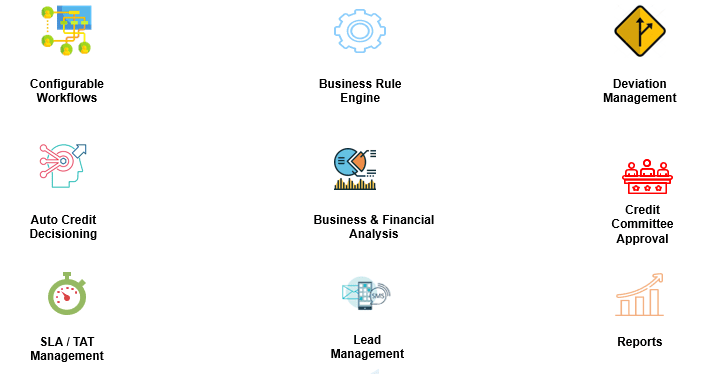
  • In-House Dynamic Business Rule Engine (BRE): Nimble offers a powerful BRE system. Lenders can configure rules for various aspects like KYC verification, loan origination, loan servicing, credit bureau checks, and more. This ensures compliance and streamlines processes.
  • Well-Defined Deviation Approval Matrix: Nimble allows for multi-level approvals when system deviations or manual overrides occur. Deviation-wise approval roles (business, risk, credit, etc.) can be configured for granular control.
 

Seamless KYC and Financial Assessment:

  • Bank Statement Analysis: Nimble analyzes the borrower’s past 6 months of bank statements, providing a consolidated view of their cash flow. This complements the customized cash flow analysis for a holistic financial picture.
  • KYC Authentication: Nimble supports Aadhaar offline KYC, PAN verification, and voter ID authentication for secure and efficient KYC checks.
  • MSME Udyam Integration: Nimble seamlessly integrates with the MSME Udyam registration system, allowing lenders to fetch Udyam certificates for faster loan processing.

Benefits for Lenders:

  • Expanded Reach: Confidently tap into the vast potential of the MSME sector with tailored cash flow analysis for each industry.
  • Reduced Risk: Data-driven decisions based on comprehensive financial health assessments lead to better loan performance and reduced risk exposure.
  • Competitive Advantage: Offer innovative loan products with risk-based pricing and cater to the specific needs of diverse MSMEs.
  • Increased Efficiency: Streamlined processes, automation, and a powerful BRE significantly improve operational efficiency for lenders.
  • Enhanced Risk Management: Granular control over approvals and dynamic rule configuration ensure compliance and mitigate risk.

Ready to unlock the power of Nimble for your MSME lending? Contact Craft Silicon today!

Author: Sriram Ganesan  |  AVP – Product and Pre-sales

Sriram is a certified PMP and CAIIB professional having more than 18 years of experience in the banking domain (retail and corporate) that spans into product management, presales, business analysis, project management . He has worked in largescale transformation projects for global banks. He has rich experience in lending domain and has played key role in launching Nimble product suite for Craft Silicon. He is a fintech enthusiast interested in learning and sharing fintech knowledge to the community. Sriram is currently leading the product management practice at Craft Silicon.

Digital Lending Clarifications from RBI

The Reserve Bank of India (RBI) introduced guidelines to regulate digital lending in September 2022. Addressing the guidelines recently Central Bank released answers to FAQ to provide clarification on the industry concerns.

With digital lending now becoming more commonplace, it is important that everyone involved in the process is aware of the guidelines and clarifications issued by RBI. This article will discuss the key points from these clarifications and how they will impact digital lending in India.

Digital Lending Guidelines:

A high level glance

  • Digital Lending Apps/Platforms (DLAs) are mobile and web-based platforms for digital lending.
  • Regulated Entities (RE) such as banks and NBFCs are required to provide a list of DLAs and Loan Service Providers (LSPs) on their website and inform borrowers of the specifics of the LSP serving as a recovery agent.


Digital Lending Guidelines:

A high level glance

  • Digital Lending Apps/Platforms (DLAs) are mobile and web-based platforms for digital lending.
  • Regulated Entities (RE) such as banks and NBFCs are required to provide a list of DLAs and Loan Service Providers (LSPs) on their website and inform borrowers of the specifics of the LSP serving as a recovery agent.
  • Regulated Entities (RE), such as banks and NBFCs, are required to provide a list of DLAs and Loan Service Providers (LSPs) on their websites.
  • Data Protection: LSPs/DLAs must not store personal information of borrowers except some basic minimal data, and explicit consent must be taken from the borrower.
  • Customer Protection: LSPs must have a grievance redressal officer to address complaints on digital lending, and explicit consent must be obtained before credit limit increase.
  • Annual Percentage Rate (APR): The effective interest rate charged to the borrower, including all costs and fees.
  • Cooling off/look-up period: A time window for borrowers to exit digital loans.
  • Loan Disbursal, Servicing and Repayment: Disbursements and repayments should happen directly between RE bank account and borrower bank account.
  • Collection of Fees and charges: Fees/charges payable to LSPs must be paid directly by REs and not charged to the borrower.
  • Disclosures to Borrowers: APR, fees, and recovery mechanisms must be disclosed upfront in the Key Fact Statement (KFS).
  • Digitally Signed Documents: Documents are automatically sent to the borrower upon execution of the loan contract.


businessman-using-mobile-online-banking-payment-digital-marketing-finance-banking-networking-online-shopping-icon-customer-network-connection-cyber-security-business-technology-scaled.jpg

Recent Clarifications Provided by RBI:     

General Clarifications:

  • A lending transaction will fall under the definition of digital lending even if some steps are carried out in physical mode.
  • Reasonable one-time processing fee collected during loan processing need not be refunded if the borrower exits the loan during loan cooling-off period.

Loan Service Provider:

  • Outsourced service providers providing activities that are listed under digital lending guidelines (i.e.: Customer acquisition, underwriting support, pricing support, servicing, monitoring, recovery of specific loan) will be classified as LSP. Any other service providers need not be categorised as LSP.
  • Only customer/borrower facing LSPs need to appoint a nodal Grievance Redressal Officer. REs will have final responsibility in resolution of complaints.
  • LSPs cannot directly or indirectly involve in the fund movement between RE and borrower (for disbursement, repayment) except in case of recovery agents acting as LSPs who are involved in collection of delinquent accounts. Even in this case, LSPs should not directly collect the charges from the borrower for collection service provided. REs should try to collect the delinquent amount from borrowers directly.

 Annual Percentage Rate:

  • For floating rate loans, APR may be disclosed at the time of origination based on the prevailing rate, and the revised APR should be disclosed via SMS/e-mail each time the floating rate changes.
  • Insurance charges relating to loan product should be considered for the computation of APR.

Key Fact Statement (KFS):

  • Penal charges on cheque bounce/mandate failure cases must be treated on per occurrence basis and must be clearly mentioned in KFS.
  • Processing fee should be clearly mentioned in KFS.
  • Both APR and annualised interest rate should be mentioned distinctly in KFS.
  • Empanelled agent details for loan recovery should be mentioned in KFS. On loan turning delinquent, appropriate loan recovery agent details should be communicated to borrower through email/SMS.

Co-Lending Transactions:

  • In case of co-lending transaction, where direct bank account transfer between REs and borrower is not possible of (as 2 REs are involved in co-lending), already exemption has been provided. This is applicable for both Priority Sector Lending (PSL) loans and non-PSL loans.

Loan Repayment:

  • In case of loan repayment on salary loans where employer deducts the loan amount from employee salary, the employer must directly credit the RE’s bank account without any interference/intermediation of LSPs.

We believe that in coming days, RBI will provide more clarifications on the digital lending guidelines which will eventually result in wider acceptance and adoption.

Author: Sriram Ganesan  |  AVP – Product and Pre-sales

Sriram is a certified PMP and CAIIB professional having more than 16 years of experience in the banking domain that spans into operations, business analysis, project management and presales. He has involved in largescale implementation of leading banking solutions with in-depth exposure to lending domain. He comes with overall experience ranging from retail and corporate banking, payments and investment banking.

Sriram has recently joined Craft Silicon as a product manager.