The Evolution of Co-lending

Co-lending has significantly evolved over the years, revolutionizing the way financial institutions collaborate to fund projects and businesses. Understanding the roots and importance of co-lending is crucial to understanding its current impact on the financial sector. Co-lending plays a fundamental role in promoting financial inclusion by providing access to capital for individuals and businesses that may not meet traditional lending criteria. It fosters innovation, enables priority sector like MSME, and facilitates economic growth.



What is Co-lending?

Co-lending involves collaboration between two types of partners: the Financing partner and the Servicing partner.

  • Financing Partner(FP): This partner contributes a larger percentage of the loan amount in the partnership. They provide the bulk of the capital needed for the loan.
  • Servicing Partner(SP): This partner is responsible for servicing loan to customer. Their roles include primary sourcing of the loan, managing loan repayments(collections), & acting as the main point of contact for the customer throughout the loan process.

In this arrangement, the financing partner ensures the availability of funds, while the servicing partner handles the operational aspects of the loan, ensuring smooth management and repayment. This collaboration allows for the pooling of resources and expertise, leading to more efficient and inclusive lending practices.

History of Co-lending

The concept of co-lending dates back to ancient civilizations, where groups of individuals would pool resources to support fellow community members in need. Fast forward to modern times, banking institutions began formalizing co-lending practices to cater to diverse financial requirements.

Reserve Bank of India (RBI) Guidelines

The RBI has issued guidelines to formalize co-lending arrangements, particularly between banks and non-banking financial companies (NBFCs). The Co-Lending Model (CLM), introduced in 2020, aims to enhance credit flow to priority sectors by leveraging the comparative advantages of banks and NBFCs.

Types of Co-lending Models

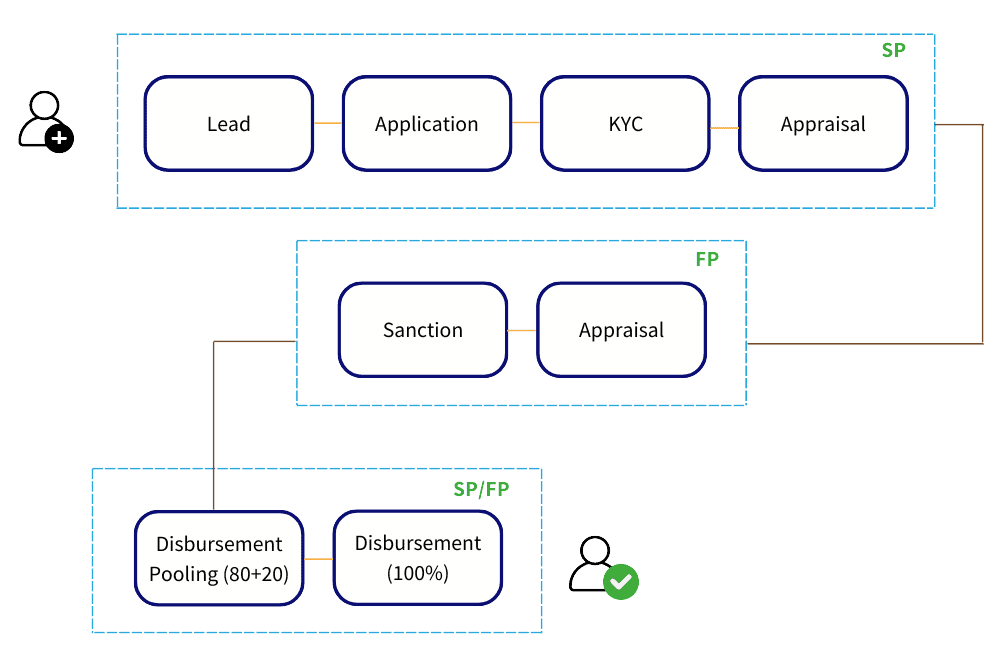
  • CLM 1 – In this model, all the co-lenders jointly fund the loan amount according to pre-agreed ratios.

For example, Lender A funds 80% while Lender B funds 20% of the total loan amount.
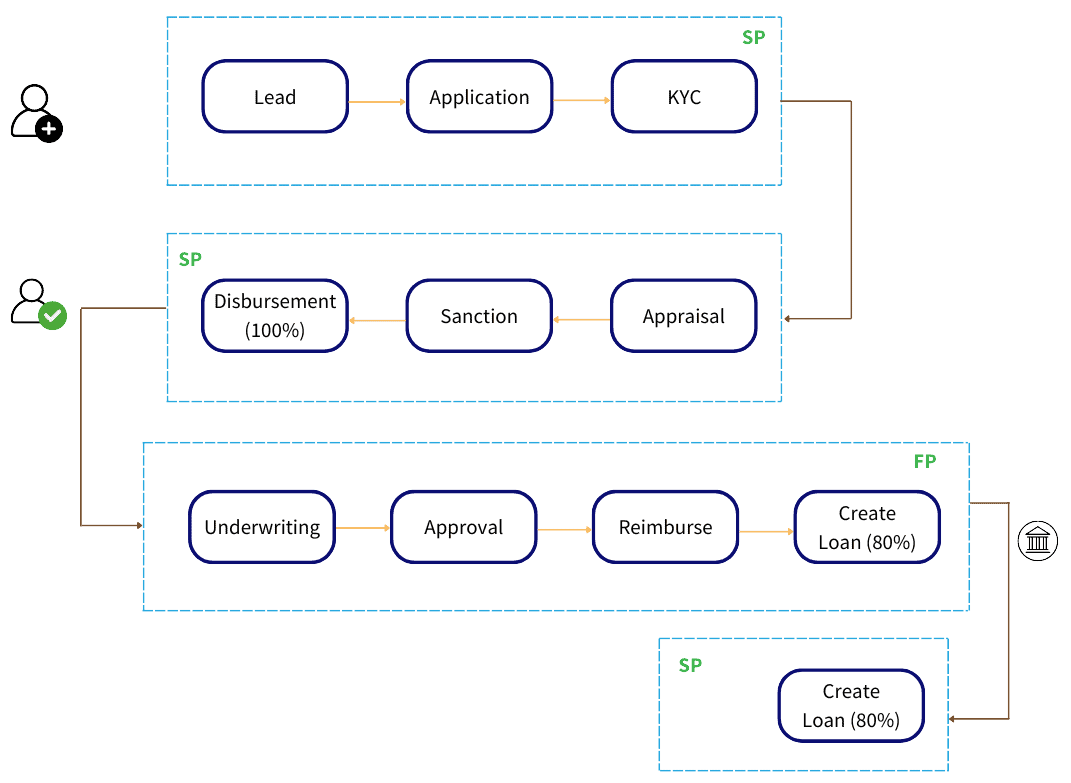
  • CLM 2- Reimbursement-based Co-lending- Here, one lender disburses the full loan amount first. Subsequently, the other lender reimburses a percentage of the loan, say 80%, to the first lender as per the co-lending agreement. This model is similar to Direct Assignment.

Benefits of Co-Lending

Co-lending offers numerous advantages for lenders, borrowers, and the overall financial ecosystem.

  • Risk Diversification- By spreading loan exposure across lenders, co-lending significantly reduces the risk of any single lender facing substantial losses. This diversification strategy enhances financial stability and resilience.
  • Increased Loan Approvals- Co-lending increases the likelihood of loan approvals for borrowers, especially those with unique or complex financing needs. Two lenders bring diverse perspectives and expertise to evaluate loan applications, leading to more inclusive lending practices.
  • Lower Interest Rates for Borrowers- Collaborative lending often results in competitive interest rates for borrowers, as lenders work together to offer attractive terms and conditions. This fosters healthy competition in the lending market, benefiting borrowers with cost-effective financing options.

For Example:

Consider a co-lending partnership involving two lenders:

Lender A has an interest rate of 18% and contributes 80% to the loan amount. Lender B has an interest rate of 14% and contributes 20% to the loan amount. The blended rate of interest for the customer can be calculated using the following formula will be 17.20%

Formula : (Funder A Share % * Interest Rate of Funder A) + (Funder B Share % * Interest Rate of Funder B)

Using the given percentages and interest rates:

Blended Rate of Interest = (0.80×18%) + (0.20×14%)

Blended Rate of Interest = 14.4% + 2.8%

Blended  Rate of Interest  = 17.2%

Challenges of Co-lending

Despite its benefits, co-lending comes with its set of challenges that require careful consideration and strategic management.

  • Coordination and Communication Issues- Coordinating two lenders, aligning on terms, and maintaining effective communication throughout the lending process can be challenging. Ensuring transparency, clarity, and accountability among all parties is essential to overcoming these hurdles.
  • Credit Risk Management- Managing credit risk in co-lending arrangements demands robust credit assessment, monitoring mechanisms, and risk mitigation strategies. Lenders need to evaluate borrower creditworthiness, set appropriate risk limits, and monitor loan performance diligently to safeguard their financial interests.
  • Technology Integration- Advancements in financial technology (FinTech) are revolutionizing co-lending processes, enabling digital platforms for seamless loan origination, underwriting, and servicing.

Solution for the challenges

Our Nimble co-lending system provides an effective solution by handling communication and balance management between both partners. Nimble co-lending acts as an intermediary, facilitating smooth interactions and operations between the serving partner and the financing partner.

  • Enhanced Coordination and Communication: Nimble co-lending ensures effective communication channels between lenders, promoting transparency and clarity. The system provides a centralized platform for sharing information, aligning on terms, and tracking progress, thereby minimizing coordination issues.
  • Improved Credit Risk Management: By monitoring Nimble co-lending helps in conducting thorough credit assessments and setting appropriate risk limits. It continuously monitors loan performance, offering real-time insights to both partners, which aids in proactive risk mitigation.
  • Seamless Technology Integration: Nimble co-lending pulls progressive solutions to loan origination, underwriting, and servicing. This integration streamlines processes, reduces manual efforts, and enhances operational efficiency, making co-lending more effective and scalable.

Through these features, Nimble co-lending plays a pivotal role as a middle layer, ensuring smooth collaboration between the serving and financing partners, ultimately leading to a more efficient and effective co-lending process.

Summary

Co-lending provides risk diversification, increased loan approvals, and competitive interest rates while requiring effective coordination, regulatory compliance, and credit risk management.

  • Lenders can mitigate credit risk by conducting thorough credit assessments, setting risk limits, and implementing robust monitoring mechanisms.
  • Borrowers benefit from increased loan approvals, competitive interest rates, and access to diverse funding sources through co-lending.
  • Technology integration enables automation, data analytics, and digital platforms for seamless loan origination, underwriting, and servicing in co-lending.

Author: Roopesh Kumar M |  Associate Business Analyst, BA Solution

Roopesh is an Associate Business Analyst at Craft Silicon, with two years of experience in the company. He specializes in financial technology integration and is dedicated to enhancing financial inclusion and operational efficiency through innovative solutions in the banking sector. At Craft Silicon, Roopesh works in new product development, focusing on lending and banking solutions.


Transforming the Way we Work- Scrum, Waterfall or just Go “Agile” – Part II

(contd. from part I…..)Transforming from Waterfall or hybrid to Agile is a significant shift in project management methodology, but it can be capitalized on with careful planning and execution. It can also bring significant benefits to an organization, such as increased flexibility, faster time-to-market, improved collaboration, and adaptability to changing requirements.

It’s important to note that this transformation requires a cultural shift, collaboration, adaptability as well as process change. It takes time and effort to overcome resistance and establish a new way of working, but the benefits of being Agile, such as faster time-to-market, better quality, and higher customer satisfaction, can be worth the investment. Therefore it’s important to communicate the benefits of agile to stakeholders and manage expectations regarding flexibility, continuous feedback, and the iterative nature of project delivery.

Proper assessment of the current state of the organization and identification of areas for improvement is important to ensure a smooth transition and implementation of the process into the company’s culture.


It’s important to note that this transformation requires a cultural shift, collaboration, adaptability as well as process change. It takes time and effort to overcome resistance and establish a new way of working, but the benefits of being Agile, such as faster time-to-market, better quality, and higher customer satisfaction, can be worth the investment. Therefore it’s important to communicate the benefits of agile to stakeholders and manage expectations regarding flexibility, continuous feedback, and the iterative nature of project delivery.

Proper assessment of the current state of the organization and identification of areas for improvement is important to ensure a smooth transition and implementation of the process into the company’s culture.

Here are some steps that we are using to transform from Hybrid to Agile:

  1. Assessing the current situation: Understand the reasons for the shift, evaluate the current processes, and identify the challenges and opportunities for improvement.
  2. Creating a plan: Develop a roadmap for the transformation, including the timeline, budget, resources, and key performance indicators.
  3. Involving your cross-functional team: Involve all stakeholders, including the development team, management, customers, and end-users, in the transformation process.
  4. Define what you need: Choose the most suitable framework and tailor it to the project’s requirements.
  5. Educate the team: Train the team on the Agile principles, practices, and tools, and ensure that everyone is aligned with the new way of working.
  6. Implement Agile practices or let’s just say best Practices: Introduce Development Best Practices such as user stories, backlog grooming, sprints, daily stand-up meetings, and retrospectives, to promote collaboration, transparency, and feedback.
  7. Adapt and improve: Continuously evaluate the process, measure the outcomes, and adapt the methodology to improve the project’s efficiency and quality.

Running Agile with Waterfall-

Agility is a characteristic of the Agile methodology, which is an iterative and incremental approach to software development. Waterfall, on the other hand, is a linear and sequential approach to project management. Agility in Waterfall can refer to the ability of a Waterfall team to adapt to changing circumstances or requirements during a project. While Waterfall is typically a more rigid methodology, there are certain practices that can increase agility in a Waterfall environment:

  1. Breaking down the project into smaller phases: This can enable more frequent checkpoints and feedback loops, allowing the team to adjust course if necessary.
  2. Regular communication and collaboration: This can help ensure that everyone is aligned and can quickly respond to changes or issues.
  3. Flexibility in requirements: Allowing for some flexibility in the requirements can enable the team to adjust as needed, without derailing the project.
  4. Continuous testing and validation: By continuously testing and validating each phase of the project, the team can catch errors or issues early on, reducing the need for major changes later.
  5. Embracing a culture of learning: Encouraging continuous learning and improvement can help the team adapt to changes and challenges as they arise.

Overall, while Waterfall may not be as inherent as Agile methodology, there are practices that can be adopted to increase agility in a Waterfall environment. Transforming a Waterfall mindset can be a significant challenge, but it is possible with the right approach. Here are some best practices for transforming a Waterfall mindset in the best possible way:

  1. Educate the team: Provide training on the principles and benefits of Agile methodology, including the importance of collaboration, flexibility, and feedback.
  2. Start small: Begin with a pilot project or a single phase of a larger project to help the team adapt to the new approach and build confidence.
  3. Involve the team in the process: Encourage the team to participate in the decision-making process and to provide feedback on what is working well and what needs improvement.
  4. Focus on the benefits: Highlight the benefits of Agile, such as faster time-to-market, better quality, and increased customer satisfaction, and show how these benefits align with the team’s goals and objectives.
  5. Emphasize continuous improvement: Encourage the team to embrace a culture of continuous learning and improvement, and to continuously evaluate and refine the Agile process.
  6. Provide coaching and support: Offer coaching and support to help the team adopt the new mindset and overcome any challenges or obstacles that arise.
  7. Celebrate successes: Celebrate successes and milestones along the way, to reinforce the team’s motivation and to build momentum for future transformations.

It’s important to note that transforming a Waterfall mindset is a journey, not a destination. It may take time and effort to fully adopt an Agile mindset, but by following these best practices, it is possible to make the transition as smooth and successful as possible. Moreover, IT IS A TEAMWORK ?

Author: Nivedita Sahoo  |  Manager, Development

Nivedita is a seasoned IT management professional with over 14 years of experience in Program Management, IT Delivery Management, Project Planning, Process Transition, Agile, SAfe, Scrum Methodologies, Software Testing, Product Development/Validation, Design Thinking and People Leadership. She has contributed in industry based research and solutioning. She has extensive experience in building Agile teams by mapping Scaled Agile, SAfe, Scrum Framework, and methodologies to address specific project needs. She is a people leader with a track record of building and coaching sustainable, diverse teams of highly talented professionals.

Transforming the Way we Work- Scrum, Waterfall or just Go “Agile” – Part I

In today’s ever-evolving business landscape, organizations are constantly seeking ways to adapt, collaborate efficiently, and deliver high-quality results. This pursuit has led to the emergence of various project management methodologies, each offering a unique approach to tackle complex tasks and achieve desired outcomes. Two widely recognized methodologies, Scrum and Waterfall, have long dominated the project management realm. However, a newer and more flexible approach, known as Agile, has gained significant popularity in recent years.

But then.. Why GO AGILE??

Agile and Waterfall are two different software development methodologies, each with its own approach to project management and software delivery. Waterfall is a traditional sequential approach to software development, while Agile is an iterative and incremental approach. It’s not a common scenario to use Agile in a pure Waterfall model, as they have fundamental differences. However, there are some instances where elements of Agile may be incorporated into the Waterfall model to increase efficiency and collaboration and vice- versa.


But then.. Why GO AGILE??

Agile and Waterfall are two different software development methodologies, each with its own approach to project management and software delivery. Waterfall is a traditional sequential approach to software development, while Agile is an iterative and incremental approach. It’s not a common scenario to use Agile in a pure Waterfall model, as they have fundamental differences. However, there are some instances where elements of Agile may be incorporated into the Waterfall model to increase efficiency and collaboration and vice- versa.

For example, our teams use Agile practices, such as daily stand-up meetings, retrospectives, or user stories, to facilitate communication and transparency within a Waterfall project. Additionally, Agile methodologies such as Scrum or Kanban could be used to manage individual project phases, such as development or testing, within a Waterfall framework.

Saying that, it’s important to note that incorporating Agile practices into a Waterfall model does not make it a true Agile methodology, but rather a hybrid approach that can potentially improves project outcome.

While the waterfall model has been widely used in the past, it is not always the best choice for software development projects. Few major problems of running Waterfall are:

  • Changing requirements: Requirements can change as the project progresses. With the waterfall model, changes may be difficult or impossible to make once a phase has been completed. This can lead to a product that does not meet the customer’s needs.
  • Delayed feedback: Because testing is only performed at the end of the development cycle, feedback on the product is not received until very late in the development process. This can lead to problems being discovered too late to be easily fixed.
  • High risk: Since testing is only performed at the end of the development cycle, any defects or issues that are discovered may require significant rework, which can be time-consuming and costly.
  • Limited customer involvement: The waterfall model typically involves limited customer involvement during the development process, which can lead to a product that does not meet the customer’s needs.
  • Time-consuming and expensive: The waterfall model can be time-consuming and expensive, as each phase of the project must be completed before moving on to the next phase. This can lead to delays and cost overruns.
  • Inflexible: The waterfall model is a rigid approach, with no room for changes once a phase has been completed. This lack of flexibility can be a problem if requirements change, or if a problem is discovered later in the development process.

Overall, while the waterfall model may be appropriate for certain types of projects, it is important to consider other software development life cycle (SDLC) models that may be better suited for the specific needs of the project.

As the way we work continues to evolve, organizations face the challenge of selecting the most suitable project management methodology for their unique needs. While Scrum and Waterfall have their merits, the Agile approach offers a comprehensive and flexible framework that enables organizations to adapt to change, collaborate effectively, and deliver value consistently. By embracing Agile methodologies, organizations can transform the way they work and navigate the ever-changing business landscape with confidence.

Author: Nivedita Sahoo  |  Manager, Development

Nivedita is a seasoned IT management professional with over 14 years of experience in Program Management, IT Delivery Management, Project Planning, Process Transition, Agile, SAfe, Scrum Methodologies, Software Testing, Product Development/Validation, Design Thinking and People Leadership. She has contributed in industry based research and solutioning. She has extensive experience in building Agile teams by mapping Scaled Agile, SAfe, Scrum Framework, and methodologies to address specific project needs. She is a people leader with a track record of building and coaching sustainable, diverse teams of highly talented professionals.

Mr. Siva Kumar, CEO Asia – Interview with CEO Insights

Craft Silicon- a technology service provider for financial institutions serving over 300 organizations spanned across more than 30 countries. Along with the growth, the company has maintained an employee friendly work culture that led to being certified as ‘Great Place to Work’.

Siva Kumar, CEO of Craft Silicon Asia, with his astute business acumen and empathetic leadership has supported the team to be instrumental behind the organization’s successful growth and positioning across the Financial Inclusion domain.

” At Craft Silicon, we believe the vision, mission and core values lie within every employee, and that’s how we are a great place to work. “

He brings with him a wealth of experience in Information Technology, Banking, and Microfinance. Having been associated with Craft Silicon, Kenya since 2000, he has held several leadership positions along his tenure leading to his appointment as the current CEO.

In an exclusive interaction with CEO Insights, Siva has shed some light on the employee engagement at Craft Silicon that makes it a great place to work while offering abundant growth opportunities.

Siva Kumar
Siva Kumar – CEO Asia


Here are the excerpts:
How would you define Craft Silicon as an organization and its position in the market?

Craft Silicon is a leading Core Financial System solution provider in the global market. It possesses a rich domain knowledge and a client-centric approach, and it is why the company holds over 40 percent market share in the small Finance Bank segment. Also, the company has a track record of having supported over two billion transactions, $7.4 billion Portfolio outstanding and around 77 million- end customers in 2021. Our mobility applications are robust & scalable to support loan origination, collection, disbursement, delinquency management, analytics and end borrower engagement while covering entire lending value chain.

Tell us about the exposure that your company offers to its employees. Also, what’s the unique work culture followed there?

I believe, work culture is the basic foundation of every organization to attract better talent and more importantly to retain that talent. Hence, we, at Craft Silicon build a workplace where the team understands their role in enabling the technology to accelerate
financial inclusion and inspire each other to work better.

Being a technology service provider, we support lending institutions to enable financial inclusion that acts as a key driver of sustained economic growth by ensuring adequate credit access to unbanked/ underbanked sections and drawing low-income groups
into the formal framework of the banking. Also, we never hold back on making our workplace fun with learning which is the perfect antidote to monotony. We ensure that every employee of our organization feels respected, secured, empowered with right product knowledge, approachable to leadership and be innovative.

Reflect on the unique aspects of your HR policy. What are the growth opportunities and recognition the employees can expect from the organization?

We at Craft Silicon have the most simplified HR Polices that are artistically crafted and in line with the needs of the employees, per se the current environmental concern. Also, the policies here are not enforced on the employees, instead they’re educated on why an organization is bound by such norms. We do so by explaining purpose during the Induction and having a Policy Training and assessment annually to
emphasize the need of such HR Policies.

We also differ in the growth opportunities for employees at Craft Silicon as we don’t have a soak in period for next promotion cycle for our employees here, instead once the talents are identified we immediately expose them to the growth opportunities and encourage them to the right career progression.

What does Craft Silicon expect from new candidates in terms of attitude, work ethics, and talent, among others?

At Craft Silicon, we prefer our new candidates to enjoy the work, understand the impact they are creating within the organization and understanding the customers’ business growth while maintaining professionalism, long term potential growth, teamwork, collaboration at
workplace, being enthusiastic, passionate, and implying critical thinking approach.

What are the ways of recognizing top talents & great performances within the organization?

We help our employees to assess their strong areas and create the platform to perform and excel in their core competencies. We also provide multiple opportunities to explore their interests in across departments for overall exposure conducting regular workshops (to improve leadership skills, empathy, and team collaboration), and once the talents are recognized we expand their learning & development
opportunities, Acknowledge, Recognize and Celebrate their achievements continuously.

Mobile Solutions To Accelerate Financial Inclusion

Mobile Solutions to accelerate Financial Inclusion : Microfinance is an industry that bridges the gap of economic inequality by lending loans to the unbanked/underbanked that benefit them in building their assets, creating new business opportunities and having a sustainable lifestyle. Being a guardian angel of the economically challenged, Microfinance fosters financial inclusion to alleviate poverty in India.

Furthermore, Internet and mobile penetration has led to the evolution of technology in the microfinance sector. However, the limited financial proficiency and formal training in rural India poses specific challenges in Microfinance operations. With the new RBI guidelines, technology (Mobility Solutions) now plays a major role in scalability, acquiring the increased target market and gaining competitive advantage through customized solutions.

Mobile Solutions for Financial Institutions

Digitization in the microfinance sector gave birth to mobility solutions that contribute to the accomplishment of financial inclusion.


Mobile solutions bring many stumbling blocks at ease. It reduces the operational costs by collecting data entirely through mobile devices, builds customer loyalty though better user experiences, empowers microfinance industries to reach out to more people and function in a uniform and organized manner.

Accelerates access of financial services in remote areas, understanding customers’ needs and behavior and upskilling people of rural India.

Craft silicon ~ Fulfilling the vision of financial inclusion  

we bring you the array of mobile solutions to combat all the challenges of field operations and expedite the aim of financial inclusion. These solutions help in improved decision making, reduction of default rates and expenses, thereby bridging the communication gap to enhance productivity.

Let’s explore craft silicon product suite that is created to envelop the entire microlending process from loan management to disbursement, collection, and delinquency management.    


GLOW

Abbreviates to group loan organization flow is a comprehensive software that has various inbuilt features that are beneficial to MFIs. Starting with village surveys, geo-location tagging, capturing demographics data and eKYC,  it enables automated field credit verification and appraisals, centralized data management, quality check for easy loan disbursements.


ILOS

Individual loan origination workflow automates the lending process by allowing the lenders to promote loan products through geo-tagging feature, seamless data entries, reference checks and loan utilisation plans.


TRUCELL

Trucell is a mobile application specifically designed to support and empower Microfinance field operations. It facilitates the lending operations for optimum loan collection, loan disbursement, Loan Utilisation payments, pre-closure, demise marking and other e-services through mobile devices. Trucell hosts a range of functions and activities to make work easier, quicker, and efficient for field officers.


TRACKOD

TrackOD supports in managing default accounts, overdue loans, partial collection, fore-closure, on-field loan settlement and write off recommendations digitally.


CUSTOMERAPP

Customer app helps the end borrowers by providing a user-friendly interface for MFIs customers that facilitates access to loan information, loan status alerts, new offers etc. in their regional language settings.

Craft silicon provides integrated low-cost digital tech mobility tools to lenders and borrowers and thereby, accelerate the growth of financial inclusion in India. This mobile initiative will fathom a lot of interrelated issues like literacy and unemployment, thus curbing poverty on a large scale!

Author: Divya Jyothi   |  UX & Marketing Manager

Divya is a goal driven Marketing and Product design professional with over 7 years of corporate experience. She oversees end-to-end marketing management by developing and executing integrated marketing strategies to advance sales and customer engagement. Functioned as a Meticulous product designer balancing multiple deadlines while maintaining an organized yet, creative approach towards user research, product interaction design, UX & UI design.

Technology – Abetting Women Leadership

Craft Silicon - International Women's Day

Women from every stratum without any identity margin are self-calibrating to be business leaders, enabling them to demonstrate their business attributes without the prerequisite of academia or experience.

Women are confidently soaring broadening their horizons by taking crucial financial decisions for themselves and their families beyond the kitchen.

My spotlight is on the rural women sector and women coming from a low-income background. Their audacity to outset a business brought a remarkable revolution of women empowerment.


No! Am not bringing the facet of gender diversity, however, the multitudinous inclusion of, women, men, and financial institutions has created an arena for women to transform their life holistically by generating income through their business activity to aim at providing a better life for their family.

Micro Finance Institution is the phenomenon that has turned the table by creating an opportunity to take a loan to change their dream to reality by pulling them out from midlife blues and re-directing towards entrepreneurship. The implication of this is trending in the rise of women leaders in business society without bars.

Craft silicon and fraternity of microfinance institutions provide automation mechanisms to enhance the performance and further, it simplifies the operations of financial institutions also contributes towards women’s entrepreneurship and financial inclusion. Craft silicon has robust technology with an apt blend of creativity and innovation for a trouble-free loan process with seamless integration, diverse features to manage the end-to-end loan process.

Craft silicon product suite ushers positive evolution in solving problems of banks and their staff. For instance, logistic issues, problems of wastage of paper, saving transition and documentation time intending for short turnaround time for disbursement.

This is rapidly aiding in solving the money crunch of women leaders. Craft silicon is one of the sturdy pillars supporting women’s leadership with a range of solutions contributing towards women’s leadership.

Women as business leaders become strong role models for their kids. They possess attributes such as:

  • Women balance work and life – Women leaders balance kids and families with their business, so they have learned to multitask and set priorities, and they encourage other women to do the same.
  • Empathy is their strength – Women are high on empathy. This strength allows them to build and nurture relationships in their business, and it helps them understand their customers and make them feel valued.
  • Women leaders are good interactors – Women leaders are good at initiating small talks. They build bonding with others quickly. This skill helps them to persuade, negotiate and also have colloquial relationships amongst their stakeholders.
  • Women leaders are emotionally intelligent – Women leaders have the blessing of managing their emotions and others’ emotions well. They are emotionally strong, which aids in handling stressful activities. They are adaptable to the situation and can mindfully take action steps during a difficult situation.
  • Women leaders handle situations well – Critical thinking and analyzing are of strength in women. Women handle crises well even during difficult situations they look for resources to handle the issue. Women leaders confidently take risks for themselves and their family welfare.
Author: Sumaiya Sultana   | Principal Trainer

With rich experience in Learning & Development domain, Sumaiya has thorough acumen on the corporate training and coaching needs and conducting Workshops for global participants this absolutely helps her to dynamically structure and design all her leadership programs to high standards. She is passionate about transforming people towards better behavioral skills, Change Management skills, Performance and Organization Development & Leadership coaching, Training aspiring as well as established trainers and coaches on developing trending instructional designing skill sets.

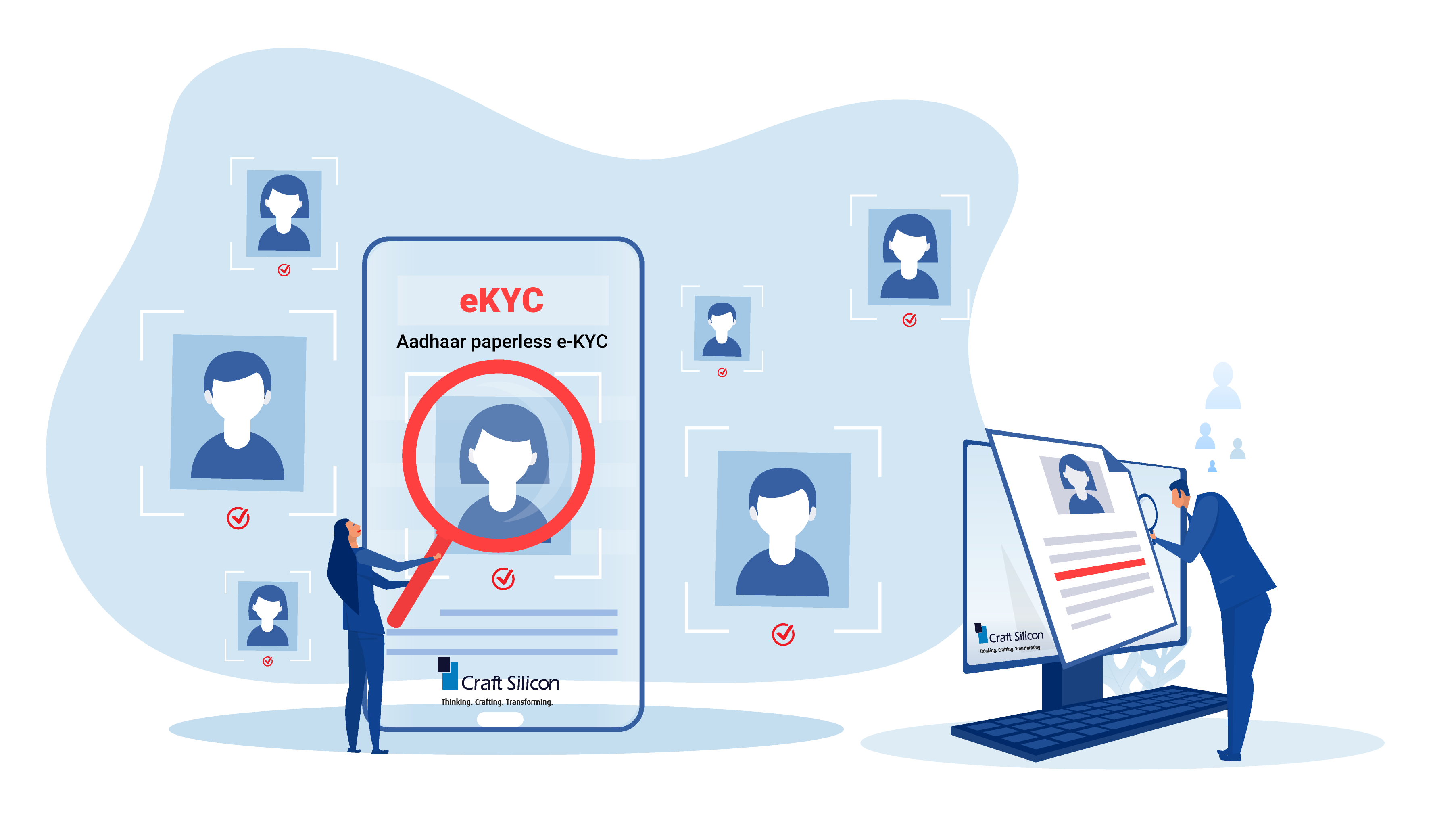
Aadhaar Paperless e-KYC for Borrower Onboarding

Paperless e-KYC (Know Your Customer) is presented by UIDAI to enforce inclusion, privacy & security. It will allow Aadhaar number holders to voluntarily utilize their cards to confirm their identification in a paperless and digital manner.

RBI has decided to invite applications from NBFCs, Payment System Providers and Payment System Participants to obtain digital Aadhaar authentication. Banks & Financial Institutions with licenses are adopting the data security measures for Aadhar Vault to enable e-KYC integration and seamless data verification.

Craft Silicon has recently tied up with Karza technologies to offer e-KYC services to the small finance banks and their BCs. It aims to offer seamless integration and real-time data verification.

The offline e-KYC approach allows Aadhaar cardholders to provide their KYC data for authentication quickly and simply. The KYC details are in an XML format. One can easily download an XML file version of their KYC information as an Aadhaar cardholder and give it to the requesting service providers or organizations. The UIDAI substantiates the XML file, which is a tamper-proof document, and it is signed electronically, adding to the security of the data being transmitted. The agencies can additionally verify the user’s identity by utilizing their own OTP or facial authentication.

Key Benefits of adopting e-KYC                                                                                                               

 ●    Cost Reduction

 E-KYC significantly lowers the cost of paper-based verification and KYC as it reduces the paper expenses that are avoided immediately, and the resources required to maintain it, like people, inventory, storage, etc resulting in massive cost-cutting.

●    Privacy

Privacy is addressed under E-KYC as the Aadhaar number of the customer is not disclosed, only a reference ID is shared. Moreover, core biometrics (fingerprints or iris) are not required for such verification. The Aadhaar number holder gets a choice of the data (among the demographics data and photo) to be shared giving the control in the hand of the customer.

●    Security

UIDAI digitally signs Aadhar KYC data to ensure its validity and detect any manipulation. Agencies can also use their OTP/Face Authentication to verify the data. Residents have control over their data since KYC data is encrypted using the phrase given by the Aadhaar number bearer.

●    Inclusion

According to the Signicat report (2020), 40% of consumers abandon the banking onboarding process in between because of the time required to complete the steps, or the need to reveal excessive personal information. E-KYC helps to reduce the time and will resolve the issue of privacy as it is voluntary and Aadhaar number holder driven.

Process                                                                                                                                                                                 
  1. Aadhar card is given to the bank officer who takes a note of the Aadhaar number
  2. Authentication is done through a fingerprint or image of the retina. Otherwise, one-time password ( OTP ) based authentication can be done.
  3. The value is transferred to the UIDAI using secure servers as soon as the instrument reads the biometric data. The input biometric data is matched against the value stored in the central database for that specific Aadhaar number.
  4. Following successful verification, the UIDAI will notify the corresponding bank or agency of all credentials, such as addresses, dates of birth, pictures, and so on, effectively eliminating the need to carry multiple needless papers.

The UIDAI allows an agent or an organization to maintain a digital or soft copy of all relevant information on their remote server, giving them the flexibility to utilize them as and when they are needed.

eKYC - Craft Silicon

Way to access e-KYC

Any person who has their Aadhaar card will be able to easily access their e-KYC data by following steps:

 ● Visit: https://uidai.gov.in/

● Download the Paperless Offline e-KYC form

● The next step will be to fill up the form carefully and submit the same

● The applicable information will be available for downloading the same as an XML file that will be digitally signed by the appropriate authority of UIDA

Data covered in offline e-KYC
 

Service providers or agencies will be able to authenticate the details. Let us see what details they will be able to see while downloading or getting offline e-KYC data included in the XML.

  • Name of the Resident
  • Download the Reference Number
  • Address
  • Photo
  • Date of Birth or Year of Birth
  • Gender
  • Mobile Number in hashed form
  • Email Address in hashed form

The Aadhaar Offline e-KYC data is encoded using a “Share Phrase” granted by the Aadhaar holder at the time of download, which must be shared with service providers or agencies for them to access a person’s KYC data or user information.

Ways to share Aadhaar Paperless Offline e-KYC Data                                                                                     

Data can be shared with the verifying agency by the Aadhaar number holder in digital or physical format along with a shared phrase.

● Digital Format: XML/PDF

○ Preferred when a high-quality photo is required

● Printed Format: QR code

○ When the resident is more comfortable with a physically printed format

○ Low-resolution photo for visual inspection only

Currently, all the financial institutions and banks are undergoing a significant digitization phase. Digital transformation has been a component of the most impactful organizational developments in the recent decade, of which e-KYC is a part.

Companies must adopt electronic identification processes with high levels of safety and reliability and follow the guidelines outlined in AML5 or eIDAS laws to guarantee that e-KYC methods match the same safety standards as traditional identification and face verification.

About Craft Silicon

Craft Silicon is a leading financial technology solution provider and recognized as one of the most tech-savvy software groups globally. Craft Silicon supports 300+ financial Institutions by delivering value in over 30 countries.  Craft Silicon provides robust solutions that include Core Banking, Loan Management, Channel Banking etc. –  Managing over $7.4Bn of Loan Portfolio, 77Mn customers & 2Bn transactions per year in Asia region.


Author: Divya Jyothi   |   Assistant Marketing Manager

Divya is a goal driven Marketing and Product design professional with over 6 years of corporate experience. She oversees end-to-end marketing management by developing and executing integrated marketing strategies to advance sales and customer engagement. Functioned as a Meticulous product designer balancing multiple deadlines while maintaining an organized yet, creative approach towards user research, product interaction design, UX & UI design.

Author: Udit Divyanshu   | Business Development

Udit is an upbeat person and finance enthusiast with an MBA from IIM Ranchi. He has an inquisitive outlook towards the finance domain and core competencies lies in financial modeling, product demonstrations and customer engagement. His passion lies in helping people understand complex concepts and bringing about constructive change.

Analytics for Financial Inclusion in Microfinance Sector

Analytics for Financial Inclusion

Data is the new oil and data-driven insights are the helping hand of modern-day businesses. Financial services are no exception, robust development in technology, new entrants, mobile phone penetration are redefining the whole landscape.

Microfinance sector amounts to a huge number of client accounts and is the center for unstructured, web and big data.

This data set contains customer details including age, income, expenses, loan purpose, occupation, attendance at meeting centers, etc leading to the increased demand for analytics to extract actionable insights.

Let’s understand the types of analytics currently being offered by the industry

Geospatial Analytics

Demographic data of the customers of a particular area or region helps to map them with viable products. This data helps to target potential customers residing in that area or region. This requirement is fulfilled by Geospatial analytics.

It helps to display customers’ location on a map of the MFI branch. Moreover, it forecasts the human population by filtering out relevant data and applying it to provide trend analysis, modeling and predictions. It analyzes and monitors the performance of the MFI branches and reviews by defining a trade area and figuring out nearby competitors.

Behavioral Analytics

It plays a vital role in determining behavioral patterns to identify whether the customer is likely to default. Accurate collection models can be a driving factor behind a product’s collection rate and efficiency. Simple classification models or scorecards can be developed on the past data to assist the collection team to pin down the group of customers in the current portfolio who exhibit a similar pattern to the ones who defaulted earlier.

The collection team can focus more on the customers with a high probability of default and align their efforts accordingly to reduce the delinquencies. This model runs at the beginning of every collection cycle, and it’s frequency will be the same as the repayment frequency (weekly, monthly or fortnightly).

Predictive Analytics

Predictive analytics delivers capabilities to mine insight from historical data and optimize solutions to reduce variability and improve operations.

It helps MFIs to reduce costs by converting raw data into business insights for better decision-making. It enables combining data across industrial sources and quickly discovering problems, identifying fundamental reasons, and determining future performance.

MFIs are using it to make better decisions for continual improvement of quality, productivity, and operations delivery. Branch-wise data is churned to determine the performance of each branch, and the executives take corrective measures to fix the laggards.

It can pinpoint the root cause of low performance and suggest the required course of action well in advance.


Predictive Analytics


Dashboard and Scorecard
Analytics Dashboard

Dashboards offer a bird’ eye view of KPIs (Key Performance Indicators) relevant to the MFI business process through constructive use of visual charts and graphs.

Analytical reporting is the most important element in presenting the desired information in different forms to the top management. This tool enables multi-dimensional analysis, what-if analysis, and data drill-down analysis.

A scorecard helps to measure and monitor the KPIs concerning the defined strategic goals and performance milestones, through effective use of traffic light indicators.

The comprehensive console provides exhaustive details to top management helping them understand trends, patterns in their business growth. With this console, executives can track, decide, and on various aspects of the business for eg. detailed analytics of expenses and revenue that helps to determine the level and cause for change in ROE

Dashboard and Scorecard


Customer Analytics

MFIs use analytics to identify the profitable customers who could also become target customers for other products and individual loans.

Customer Lifetime Value or CLTV is a measure used for calculating the value of a customer relationship, based on the NPV or Net Present Value of the projected future cash flows from the customer. Those with negative NPV should not be considered in this respect while consistent effort should be made to improve recoveries from such customers. Profitability and the lifetime value of the customers facilitate comparison with peer groups and indicate customer sentiment and the probability of attrition.

Analytics can also assist to determine a customer’s SOW or Share of the Wallet, which is the amount of the customer’s total spending on the products and services offered by the MFI. SOW can be enhanced by up selling and cross-selling other products or services thereby creating loyalty.

Conclusion

Through the assistance of predictive analytics and profitability-based customer analytics, MFIs can improve the quality of loans and reduce delinquencies. Moreover, mobile and cloud-Based analytics enable access from anywhere on any mobile device to the senior executives of the organization.

Big Data will help the Microfinance industry to reach a milestone where they will have the facility to provide products that customers exactly need. MFIs will be capable of serving customers with just-in-time financial needs, with the best-suited loan ticket size and insurance schemes.

As the famous saying goes “work smart don’t work hard”. Big data works on the same mechanism to structure the unstructured data and deliver useful insights.

About Craft Silicon

Craft Silicon is a leading financial technology solution provider and recognized as one of the most tech-savvy software groups globally. Craft Silicon supports 300+ financial Institutions by delivering value in over 30 countries.  Craft Silicon provides robust solutions that include Core Banking, Loan Management, Channel Banking etc. –   Managing over $5.6Bn of Loan Portfolio, 57Mn customers & 1Bn transactions per year in Asia region.

BR Analytics –

BR Analytics, using inbuilt deep domain knowledge, provides analytical solutions to improve business decisions & optimize performance. An intuitive system, it allows for interactive /visualizations of business insights & predictive analytics capabilities, converting raw data to actionable insights –

  • Reads multiple sources – big data, web data & unstructured data
  • Convenient plug & play system with core BR.NET allowing quick deployment
  • Real-time data analytics for business insights across industries
  • Detailed reporting includes KPIs, dashboards
Author: Divya Jyothi   |   Assistant Marketing Manager

Divya is a goal driven Marketing and Product design professional with over 6 years of corporate experience. She oversees end-to-end marketing management by developing and executing integrated marketing strategies to advance sales and customer engagement. Functioned as a Meticulous product designer balancing multiple deadlines while maintaining an organized yet, creative approach towards user research, product interaction design, UX & UI design.

Author: Udit Divyanshu   | Business Development

Udit is an upbeat person and finance enthusiast with an MBA from IIM Ranchi. He has an inquisitive outlook towards the finance domain and core competencies lies in financial modeling, product demonstrations and customer engagement. His passion lies in helping people understand complex concepts and bringing about constructive change.

Loan Origination for Microfinance

GLOW – Group Loan Origination

India witnessed a shift in the microlending landscape in the last decade. Approx. 60 million women across the nation have a massive outstanding loan portfolio of INR 2,59,377 crore in March 2021, says a report (Micrometer by MFIN) .

To meet the evolving consumer demands, the industry has transformed their entire lending process which includes a faster, secured, scalable and streamlined borrowing experience to the end customers. Increase in mobile penetration across rural markets has paved the path for digital emergence. The major factors which have led to a spur in growth are – increased digital connectivity and innovation.

Tech driven solutions are disrupting microfinance lending from loan origination to disbursement. Digitized loan origination automates and manages every step of the lending cycle such as loan application, documentation, verification, credit bureau check etc. It speeds up processing and approval of loans faster. It further streamlines lending operations and minimizes the credit risk with business rules & CB report.

Tech driven solutions are disrupting microfinance lending from loan origination to disbursement. Digitized loan origination automates and manages every step of the lending cycle such as loan application, documentation, verification, credit bureau check etc. It speeds up processing and approval of loans faster. It further streamlines lending operations and minimizes the credit risk with business rules & CB report.

Amidst the thrive of microfinance institutions, Group Loan Origination used to be a cumbersome and document intensive process by which a borrower applies for the loan. Nowadays, with the increased use of automation & digitization this process is becoming easy and quick.

Let’s understand the whole process of loan origination in a brief manner.

Loan Origination Process
Village Survey

Village Survey

It is conducted to extract the basic information of the village like population structure, business activity, financial dependencies, social dynamics, law, and order scenario etc. It is used to assess the viability of the residents of the village from a bird’s eye view to begin with the credit operations.

Lead Generation

It refers to the action of identifying the potential clients through village surveys and briefing them about the company and its products. It helps to stimulate the interest of the borrowers and increase their awareness about the loan product.

Pre-Qualification

It helps to check the eligibility and authenticity of the borrower for a particular loan product. Borrowers must provide ID and other documents to establish their eligibility. Following documents are demanded by the lenders

  • Voter Id or Aadhar card
  • Address Proof
  • Bank Account details
  • Consent for e-KYC with biometrics or OTP

These documents are verified by the lender and the credit score of the borrower is also checked. Once the screening out of ineligible candidates is done the borrowers are allowed to proceed with the loan application.

Loan Application

Borrower provides all the relevant information in a detailed manner to the officer. The application is intensive and requires all the information like financial history, monthly income and expenses, bank account, insurance, loan purpose etc.

Loan Underwriting

It is a due diligence process where the lender does deep scrutiny of the applications and the Credit Bureau report can be reviewed, if required, to check the authenticity of the details provided by the borrower. Applications are sent back for correction if any error is found at this stage.

Customer Onboarding

Finally, the customer receives the decision on approval of their loan application and a loan card is provided to them. Within 7 days of onboarding the disbursement is done in the customer’s bank account.

Traditionally, loan origination was an intensive, time-consuming and complicated process as it involved manual underwriting and paperwork which is where digitization offers the chance to deliver rapid and responsive services to the borrowers in a manner that has never been done earlier.

Benefits of Digitization
Digitization

Reduced TAT (Turnaround time)

It promoted speed and efficiency as the verification process can be done digitally through eKYC, Video KYC, eSign, etc. therefore, reducing the turnaround time by almost 50 %.

Increased Scalability

Robust technology helps to scale up the business operations in a swift manner. It takes less time for the whole process, so more customers can be onboarded as data and ID images are available across the organization to scrutinize it

Lower Cost

Digital software streamline the operations and result in more accuracy thereby reducing the cost per transaction. Features like integration with credit bureaus and other third parties, automated reporting to the branch helps in making the right decision that saves on cost.

Enhanced Accountability

Digital sourcing, data driven processes and the correct use of tech-enabled services have helped to reduce human intervention making the processes more accountable and accurate. It becomes easier to mold the process according to the dynamic regulatory environment.

Robust Analytics

Analytics helps financial firms to yield instant, automating the KPIs (Key Performance Indicators) of the business operations. It offers flexible features like highly customizable applications, and extensive third-party integrations. Moreover, predictive analytics are transforming the industry while inducing decisive promptness.

Road Ahead
Digital Adoption

Educating Customers

Low digital and financial literacy of the customers poses a challenge for the MFIs, it requires customer education and spreading awareness to build trust and establish reliability.

Digital Adoption

MFIs handle employees and business correspondent partners with limited formal education and financial training of the field staff. This limited understanding of the banking infrastructure and digital services available leads to limited adoption in the ecosystem.

Advanced Data Security

Ensuring a secure and encrypted database for storing personal data is essential. Data protection and cybersecurity is of utmost concern for a successful digital adoption while ensuring business continuity.

Self-Onboarding 

Having acknowledged the requirements of today’s customers, MFIs are transforming their processes to offer an experience that is comfortable and easily accessible. The whole process of onboarding is completely digitized, and customers do not require to go to an office or branch. Documentation is done through APIs and video KYC helps in real-time customer verification. It is possible with the advent of the digital onboarding to apply for a loan remotely with the same security and trust.

Digital loan origination will ensure streamlining of operations and ease of entering data quickly for the field officers. It will be cost effective and add value across the chain to make a considerable impact.

MFIs success depends on their ability and agility to adapt to the digital services for loan origination and management. MFIs are embracing digital transformation by harnessing the potential of their business network and partnering with fintechs to deliver personalized, digitally enabled services.

About Craft Silicon

Craft Silicon is a leading financial technology solution provider and recognized as one of the most tech-savvy software groups globally. Craft Silicon supports 300+ financial Institutions by delivering value in over 30 countries.  Craft Silicon provides robust solutions that include Core Banking, Loan Management, Channel Banking etc. –   Managing over $5.6Bn of Loan Portfolio, 57Mn customers & 1Bn transactions per year in Asia region.

GLOW – Group Loan Origination Workflow is a customized software with capability to capture the entire loan portfolio data in one place from the initial village survey, loan origination and to the final disbursal stage. It has Comprehensive loan tracking mechanism from origination to disbursement

  • Digital KYC
  • Centralized data management
  • Real-time access with authorization controls

Trucell – Field Operations made easy –  A mobile application specifically designed to support and empower Microfinance field operations. Key modules include Loan Collection, Loan Disbursement, Loan Utilization, Fees Collection and Repeat Loan Processing.  Trucell hosts a range of functions and activities to make work easier, quicker, and efficient for field officers.

Author: Divya Jyothi   |   Assistant Marketing Manager

Divya is a goal driven Marketing and Product design professional with over 6 years of corporate experience. She oversees end-to-end marketing management by developing and executing integrated marketing strategies to advance sales and customer engagement. Functioned as a Meticulous product designer balancing multiple deadlines while maintaining an organized yet, creative approach towards user research, product interaction design, UX & UI design.

Author: Udit Divyanshu   |  Business Development

Udit is an upbeat person and finance enthusiast with an MBA from IIM Ranchi. He has an inquisitive outlook towards the finance domain and core competencies lies in financial modeling, product demonstrations and customer engagement. His passion lies in helping people understand complex concepts and bringing about constructive change.

RBI Moratorium Circular – Challenges, Solutions & Learnings

As the pandemic relief, RBI introduced the loan moratorium from 1st March 2020 to 31st Aug 2020 to help businesses and individuals. Interest on the loans will keep getting accrued, but a borrower will not be tagged as a defaulter for non-payment.

“All Urban Cooperative Banks/ State SCoperative Banks/ District Cooperative Banks, All All India Financial Institutes, and All Non-Banking Financial Companies to be guided by provisions of the scheme take necessary actions within the stipulated timeline “- RBI


Challenges

Bankers Realm Core Microlending solution (BR.NET) works on account by account restructuring with interest due as on the date of capitalization.

Based on the first circular, a blanket moratorium for April/May and RBI Moratorium (1st March 2020 to 31st May 2020) was to be provided for all standard Loan Accounts – for this, a process needed to be established in bulk which was not feasible to execute for each account.

We had prepared a “Process Note” and circulated it on the 1st of April to all our clients, explaining the solution to them one by one.

As BR.NET is an Installment Schedule based system, interest Accrual and recovery was depended on it. Any change in the data would have hampered the basic functioning of the system. Interest accrued during this period was receivable in the future, it could not be included in the instalment schedule, and was needed to be capitalized at the end of the moratorium period.

On 23rd May 2020, RBI issued another circular wherein the moratorium was extended by three more months, i.e. up to 31- Aug-2020, Before this circular, moratorium capitalization was scheduled on  31st May 2020, this extension of moratorium period called for a change in strategy for 31st May 2020, and future period i.e. 1st Jun 2020 to 31st Aug 2020.

A new script was prepared for processing moratorium at month-end from Jun-20 onwards. Pre-closure or maturity Loan Account during this period was provided with options for collections before capitalization.

Accommodating customized solutions based on two circulars at two different times compelled us to change strategies, demanding extra time and effort.  Few Customers decided to go ahead with moratorium Interest capitalization on 31st May 2020 and to capitalize on every month-end and if the instalments were unpaid, same would continue till 31st Aug 2020. This called for individual customization based on different decisions by each customer which made moratorium interest calculation a very complex process.

Solutions

1st RBI Circular Solution on 27th Mar 2020 had the following objectives.

  • Providing blanket moratorium for unpaid instalment from 1st March 2020 and Apr/May 2020 instalment.
  • Ensuring March Month interest earnings does not drop, even after unpaid instalment Interest accrual on the due date are reversed after the moratorium.
  • Moratorium Interest is included in Instalment Schedule with 20th June 2020 due
  • Month-end broken period interest accrual for March, April & May was taken care with the above
  • After moratorium interest capitalization, the following were provided.
    • New instalment amount would be calculated on revised POS
    • Future instalment interest would be calculated on revised POS
    • No Recalculation of Interest – Moratorium would be recovered in Last few instalments
    • The Loan tenure would be extended with the same Installment Amount.
  • Scripts were developed with the above functionalities within a short period and QA Team started testing the solutions simultaneously.  The solutions were developed with parameterization to take-care of the different moratoriums.
  • A task team was formed to coordinate with a set of clients, who would discuss and configure the required functionalities by executing the script in UAT and sharing the output with clients for verification.
  • Moratorium Interest would be recalculated on 31st May 2020 and it should be capitalized with the future instalments scheduled to be redrawn based on the configurations (Same EMI and Extend Tenure, Interest Recalculation).
  • For Future months, Instalments would be kept on scheduled due dates, with the following action to be taken during the Month-end.
    • Unpaid instalment would be pushed to next month due
    • Interest Receivable to be
    • Excess Installment Amount paid during the month would be adjusted by preponing the Installment (1, 2 or 3 based on the payment amount).
    • Calculation of the Moratorium interest for May-20 and keeping Moratorium Interest table for the purpose mentioned above
    • Above 3 steps had to be executed on 31st May 30th Jun & 31st Jul 2020.
    • Recalculation of the moratorium interest on 31st Aug 2020 and capitalization to be done.
Learnings
  • Flexibility: System should accommodate sudden changes or urgent requirements from Regulatory / Statutory / Nodal Agencies. Moratorium provided during COVID-19 Pandemic period is going to be a regular feature in the future days to come, BR.NET has been added with a feature of providing moratorium and capitalize interest whenever it is required.
  • Multiple Moratorium Interest Capitalizations during Loan tenure: Many Operational and Finance Reports were not showing correct Loan Balance after capitalization. Those had to be identified and the script was needed to be modified to include Interest capitalized for one or more time during the Loan Tenure.
  • Dependency on Installment Schedule: Instalment schedule is the main component in BR.NET – for DPD, Overdue calculation, calculating Principal and Interest due were recovered for any specific period. The dependency on the Instalment schedule had to be avoided to handle Loan Accounting process in future.

Even after multiple changes in strategies and solutions, the development team kept up with the pace and implemented necessary features in a short period, along with testing, and the release for UAT.

Author: Venugopala K   |   Head of Solutions, Asia

Venu is a veteran of the Banking, Logistics and MFI domain with over 30 years of corporate experience, with the last 15 years at Craft Silicon. Solutions, design and implementation are his forte and he has integrated design & implementation to best serve the business needs. Venu has contributed extensively to the growth of BR.Net.